25 February 2010

Laughing at fate

I know one shouldn't take the annual Academy Awards seriously. It has absurdities such as Avatar even being nominated for "Best Picture", let alone that it is more likely to win than, say, Inglourious Basterds. But come Oscar time I just can't help myself. Call it a guilty displeasure.

That said, the best picture nominee list this year is not bad. Had the Academy stuck to the usual five pictures for this category, and had they been Up in the Air, District 9, Inglourious Basterds, A Serious Man, and Up I would have been very impressed. Every one of those films is recommended from me. (The Hurt Locker and The Blind Side have not yet been released in cinemas in NZ, and I missed An Education as it finished its cinema run before I found out it was one of the chosen few. I hope to catch Precious this weekend.)

Of the six nominated films I have seen so far, only Avatar has disappointed. However, initially I was also a little disappointed with A Serious Man.


[WARNING: This commentary is best read after viewing the movies discussed, A Serious Man and Up in the Air. Partly because it contains some spoilers (albeit vague ones), but mostly because I can't be bothered to summarise the plots.]

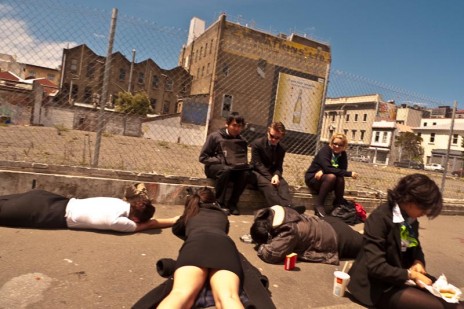
You could almost justify going to A Serious Man just to see the scene which gave us the brilliant still above. As is often the case with good films set in what are usually considered drab or uninteresting environments (rambler home studded bland suburbia in this case) the visuals are surprisingly engaging.

However, although it has largely been reviewed positively, I have sympathy with some of the criticism of the Coen brother's latest effort. I quite liked Joe Morgenstern's sly take on the question posed in the film: what does God want of us? "What do the Coen brothers want of us?" he wonders.

Sometimes I feel as if the Coen's use the "black comedy" label as an excuse to portray the sort of "repellent ... grotesque" caricatures Morgenstern has concerns with in his review. With the exception of the protagonist, physics teacher Larry Gopnik (Michael Stuhlbarg), no one is really likeable, and almost everyone is infuriatingly selfish. Characters like Gopnik's nemesis Sy Ableman are not evil in a straightforward Ming the Merciless way, but they aren't far off, being very nearly as flat and clichéd. They all serve largely as cogs in the plot machine for the Job-like journey of the protagonist (almost the opposite of the previous Coen film, No Country for Old Men).

Gopnik seems to maintain his faith throughout the trials of the story, such as his wife leaving him for the aforementioned Ableman, an absolutely repugnant fake of a human being. Yet his faith, honesty, and a portion of dignity remain, while he understandably questions what all that means.

But Gopnik rarely seems to give serious thought to anything else, other than asking "what does it all mean", or "why does this happen to me" and similar questions when things go wrong (which happens a lot).

As Morgenstern mentioned, Gopnik describes Heisenberg's uncertainty principle by explaining that it "means we can never know what's going on." When explaining to a desperate student why he has failed a term test, Gopnik says he failed the maths. The student responds by claiming to have understood the theory in the story of the cat (in reference to Schrodinger's cat). Gopnik brushes this off as mere metaphor - it's really just about the maths. "I mean, even I don't understand the dead cat. The math is how it really works."

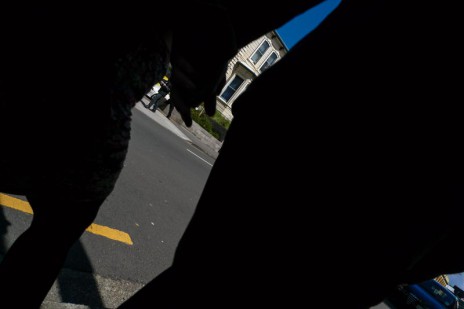
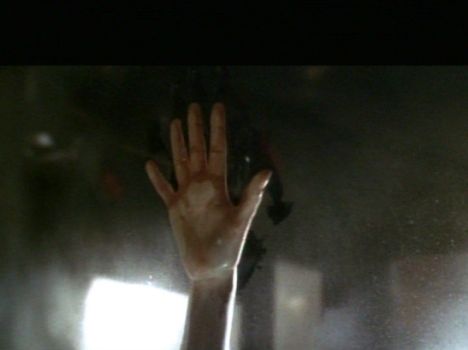
In the end, Gopnik's maths washes over him like a Tsunami, as in the image above, perhaps representing his tenuous grasp on the domestic reality that is rapidly untangling around him. At the very end of the story, when things seem like they might be about to look up for Gopnik, he is presented with a moral dilemma - and lo, he is weak. In the context of all that has happened to him many will find his weakness here understandable. But not his God, it seems.


No, not me - I'm an island of such great complexity.
(Pavement - "Shady Lane".)

Another film from the Oscar list this year that could broadly be categorised in the same genre is Up in the Air, my favourite movie of those nominated. Another comedy, this is a sort of 'romantic comedy' rather than a 'black comedy'. However, at times its humour is equally dry.

George Clooney plays frequent flyer extraordinaire Ryan Bingham, who has the job of crossing flyover country in order to assist people in their transitional phase of life - that is, he tells people they no longer have a job. In the process he finally seems to meet that special someone. Also, his own job (at least as he thinks it should be done) may well be under threat.

The depiction of the lone traveller 'man-is-an-island' lifestyle that is practiced and preached by Bingham is done perfectly. The acting is excellent (nominations for Vera Farmiga and Anna Kendrick), the script is about as good as mainstream Hollywood romance gets, and the politics is fairly evenhandedly dealt with by libertarian Jason Reitman (director and co-scriptwriter, along with Sheldon Turner).

But it is myopic to see this film too much in terms of politics or even romance per se. As cheesy as it may sound, this film is a rare instance of Hollywood living up to its own promotion: it is about a man trying to make a connection, in a world increasingly built around superficial connectedness.

Both A Serious Man and Up in the Air are funny movies. Neither film gives us a particularly happy ending, but the former is, ironically, trapped by its own genre nature - forced to buy into its black-comedic biblical twist. Despite the bitter pill delivered at the climax of Up in the Air, it still offers at least the possibility of hope and change, even with its downbeat ending.

There are fewer flaws and problems with tone and intent in Up in the Air than in A Serious Man. They have in common protagonists that try to maintain a certain sense of dignity in the face of what happens around them (albeit more cynically so in the former). Both protagonists have some idea of a faith or philosophy of life that they hold on to, rightly or wrongly, for most of their story. Both betray that philosophy at a crucial point, and in both cases, be it though fate or contingency, they pay a price for that decision.

03 February 2010

Stephen to Academy: You Basterds


A couple of years ago I made a commitment to myself to watch every Oscar 'Best Picture' nominated film. It was an easy year to do so, with There Will Be Blood, No Country for Old Men, Juno, Micheal Clayton, and Atonement on the "Best" list. In the end, second best No Country won the Oscar.*

I failed to meet my commitment the following year, but I am determined to get back to the cinema to judge Oscar choices this year.

So fuck you, Academy.

Why? Because the 2010 Oscar nominations are out, and this year the Academy of Motion Picture Arts and Sciences has changed back to ten nominations for the Best Picture category.

Ten films in a short space of time. Okay, it's not so tough as that, because I've already seen four of them. Three of those were pretty darn good: Up, District 9, and Inglourious Basterds.

One, Avatar, was pretty darn crap.

And given the Academy's record of highly questionable taste, I'd be surprised if more than half of the remainder will be worth seeing.

Well, we'll see - I have until 7 March (US).

--------

* There Will Be Blood was the best movie, but No Country for Old Men was also excellent. Juno and Atonement were not bad and had aspects of interest, and Micheal Clayton was somewhere in between.

25 December 2009

Celebrity justice, broken clocks & hidden Tigers

I'm a bit late in writing a substantial comment on the celebrity name suppression issue regarding a musician's sexual antics in Wellington earlier this year. I just have a couple of thoughts I want to get down, and will not be breaking the court order. However, as most people probably realise, it seems anyone who really wants to know can find out the suppressed name anyway.

This brings up the first issue. I wonder of this incident has been the death knell for that kind of name suppression. It seems to me that, rightly or not, people just do not respect this use of name suppression. I'm referring to when the suppression is for the benefit of the perpetrator, as opposed to the victim, and when the intent is to protect a reputation, as opposed to allowing for the completion of a fair trail. Given the way modern communication technology operates, I just can't see any other similar decision holding any more authority than this one.

Secondly, it's very rare that I have any sympathy or find much agreement with right-wing blogger Whaleoil (Cameron Slater), but I do broadly support his stance on this issue. Slater is in some trouble with the authorities after allegedly giving out enough clues to identify the entertainer and another celebrity who also has name suppression. I do not know so much about the latter case and the circumstances are different, so for the purposes of this post I'll be addressing the first case only.

I see this matter as basically being a question of whether the courts should concern themselves with protecting the reputation of an offender. The reason given for the discharge without conviction and permanent name suppression is that otherwise the consequences for the offender would supposedly have been out of proportion to the offence committed. Finlay Macdonald touched on this in a Sunday Star Times article (quoted from this Hard News column):

Yet the media are the very ones who create such a special class in the first place, and there's something a little disingenuous about stoking society's celebrity obsession on the one hand while demanding celebrities receive no special treatment on the other. One might even call it hypocritical.

You can call it the price of fame, but surely the price should be relative to the alleged crime.


Well, I don't like the way the media encourages the public's inane celebrity obsession either, but that is a separate issue. It is not hypocritical for some, including some in the mainstream media, to maintain that celebrities should be treated the same as "regular" citizens when it comes to conviction and sentencing for their criminal behaviour. As for the price being relative to the crime, it seems to me that the court's role is to ensure the sentence it applies is fair for the crime committed, taking reasonable account of the circumstances in which the criminal act took place. It is not its role to protect the accused from the wider repercussions of their own behaviour. That is what is happing here that Macdonald and Russell Brown et al don't seem to appreciate: the perpetrator of a crime is being given special protection from the consequences of his asinine actions simply because those actions brought him to the attention of the courts.

Consider another recent example of a misbehaving celebrity: the Tiger Woods affair (well, affairs). I've found much of the reaction to his transgressions somewhat sanctimonious. I don't condone what he did, but is it really that bad in the scheme of things? Should we even be so precious when we find out that many of these sports superstars are not (shock horror) the ideal role models we seem to want them to be? Macdonald again, on the NZ celebrity case:

The offence wasn't trivial, but in the context of the horrors the courts routinely deal with, it's hard to argue it merited more coverage than a far more serious assault by a nonentity.


Wouldn't this sentiment apply to Woods? Does he deserve more scrutiny and media coverage than any number of other people who have engaged in similarly dodgy conduct? The NZ celebrity, by comparison, has benefited from his conduct being regarded as actually criminal - putting it before the court and thus providing the option of name suppression at the conclusion of the process. As I suggested on Public Address [see comments for my original typo], the way for a celebrity to protect his reputation from the damage that can come from behaving like a fuckwit is to avoid behaving like a fuckwit. His reputation is his to look after, not the courts. Had the judge decided not to suppress the identification of the offender, any price this celebrity paid in terms of his reputation should be seen as the result of his own actions, not as a punishment of the court.

Back to Russell Brown from his blog:

Ironically, had he actually been named, the man would have been guaranteed a sympathetic run from the same media organisations who have been pursuing him -- in exchange for an interview. The Sunday Star Times was, for example, only too happy to softball Clint Rickards in exchange for pictures with his daughter. Such is the trade of celebrity value. The moral line can easily be moved to suit.

Yes yes, the media can be pretty shit. A capricious, shallow, hypocritical lot - well, much of the time. But the 'pro-suppression' arguments seem to be more about a distrust and (understandable) dislike of the way some aspects of the media work in regards to this sort of thing, rather than actual philosophical objections in terms of the broader justice issue. A more legitimate concern would be with why is the media and society in general so ridiculously celebrity obsessed, and relatedly, why does society naively persist in treating celebrities as role models or paragons of human conduct?

18 December 2009

Shoot from the hip

First, a quick note from the Admin part of my brain. I have been especially slack lately in blogging, exacerbated by now being back in full time employment. Nevertheless, I hope to get in at least one, maybe two more blog posts on Booksmart before going away on Boxing Day for two weeks for my first trip to the South Island of the country I have lived in for virtually my whole life.

Second, another brief plug for Photospace (no, I don't get paid for this!). It's been done before, but I quite like the look of the upcoming "from the hip"-style photography show from Gabrielle McKone. (I thought August 09 was a particularly good month.)


Three Stories Up opens Monday, 21 December outside Jimmy Cafe on Courtenay Place. The show is curated by Photospace's James Gilberd, and will be the next light box exhibition at Courtenay Place Park.

07 October 2009

Some links to optimism

I was cleaning up round the place and found this here blog. Better give it some exercise, I guess.

I had reason to link to a presentation from a TED conference during a debate I had on on morality over at Public Address. It's a good talk by Steven Pinker about the the perception many seem to have that the world is a more violent and brutal place than ever. Pinker mentions the "non-zero sum" theory by Robert Wright, and I have since noticed that this is expanded on by Wright in an earlier TED talk in 2006.

I don't entirely agree with everything Wright proposes, but no doubt there's something to it, and it makes for useful viewing before the Pinker talk from 2007. Pinker argues that (contrary to common views) we have in fact become a lot less violent over the centuries, and we are living in the most peaceful time in our history. He suggests reasons why things have improved and makes some very interesting points about the way we often perceive violence, the media's role in this, and how we should be a lot more positive, in some ways, about what humanity has achieved.

Robert Wright on optimism

Steven Pinker on the myth of violence


TED talks are covered by Creative Commons license.